


Table Of Content
- Why You Need Mobile Device Management Solutions.
- Key Capabilities of Modern Mobile Device Management Tools
- How BYOD Mobile Device Management Changes the Equation.
- Vendor Spotlights: Hexnode, Microsoft Intune & 42Gears
- How Mobile Device Management Solutions Work (Architecture Overview)
- Choosing the Right Mobile Device Management Tool for You
- Common Challenges & How to Overcome Them
- Best Practices for Effective Mobile Device Management Solutions
- Cloudcore's Role & Value Proposition
- Conclusion
Best Mobile Device Management Solutions & BYOD Tools.
In today's digital workplace, organizations must secure, monitor, and manage mobile endpoints with confidence. Mobile Device Management Solutions play a pivotal role in enabling IT teams to enforce policies, protect data, and support flexible work models. In this article, we'll explore leading mobile device management tools, strategies for BYOD mobile device management, and vendor comparisons so you can choose the right path with Cloudcore's guidance.
Why You Need Mobile Device Management Solutions.
- Smartphones, tablets, and laptops now hold business-critical data. Without MDM, risks like data leakage, malware, and unauthorized access increase dramatically emphasizing the need for strong
- Remote and hybrid work models demand control and visibility across devices.
- Regulatory and compliance pressures in the UAE and GCC require strict policies and auditing.
- MDM is fundamental to a zero-trust, endpoint-centric security strategy built on the principles of
Key Capabilities of Modern Mobile Device Management Tools
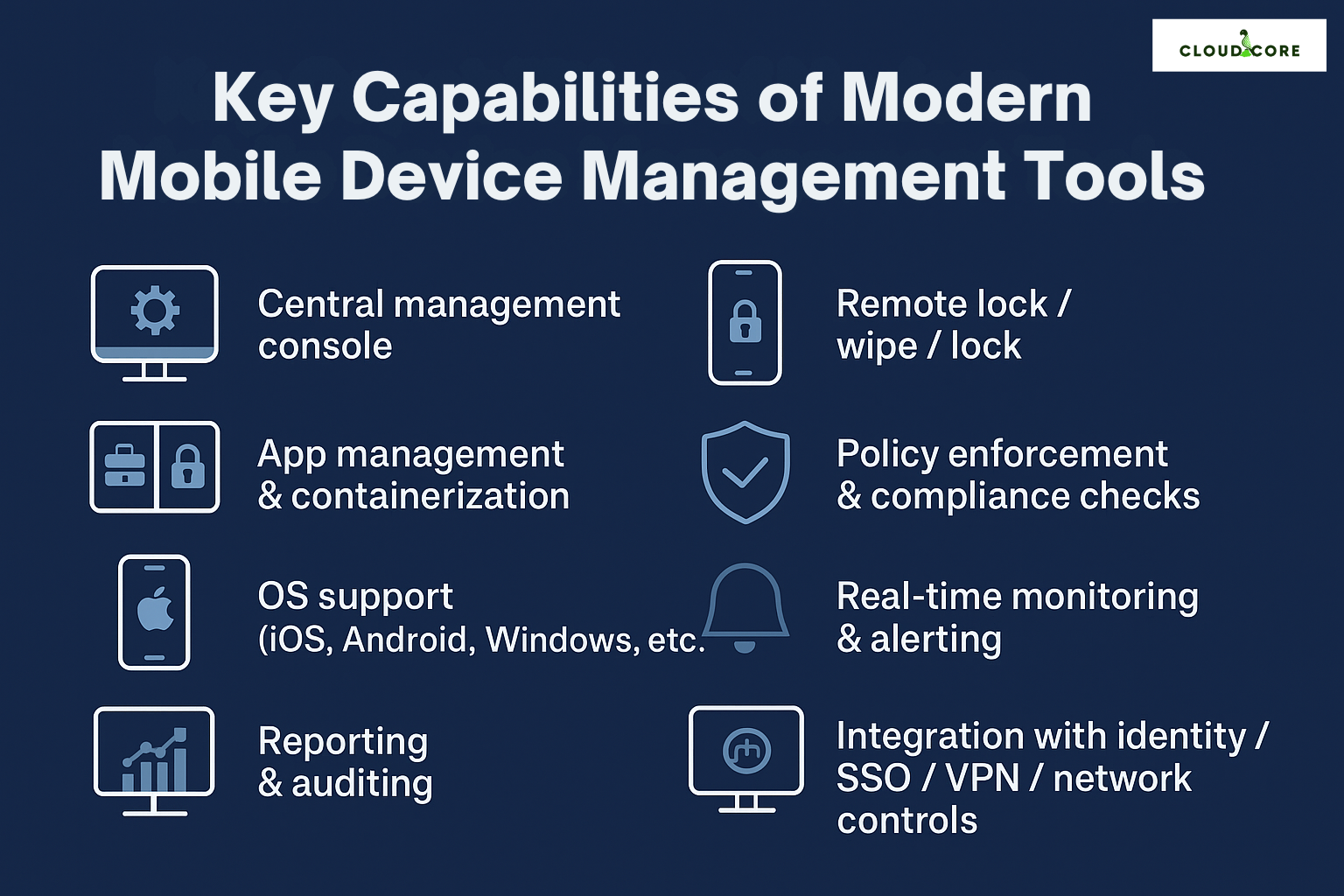
To evaluate any platform, ensure it offers:
| Capability | Why It Matters |
| Central management console | IT can push policies, updates, and configurations from one dashboard |
| Remote lock / wipe / lock | Critical when devices are lost or stolen |
| App management & containerization | Separate corporate apps/data from personal ones, especially in BYOD |
| Policy enforcement & compliance checks | Require encryption, passcodes, jailbreak/root detection |
| OS support (iOS, Android, Windows, etc.) | Heterogeneous device environments are common |
| Real-time monitoring & alerting | Detect suspicious behavior or compliance violations |
| Reporting & auditing | For compliance, forensic, or governance needs |
| Integration with identity / SSO / VPN / network controls | Seamless user experience and security |
Modern Mobile Device Management Solutions empower IT teams with deeper visibility, faster policy enforcement, and stronger compliance alignment.
How BYOD Mobile Device Management Changes the Equation.
BYOD (Bring Your Own Device) presents unique challenges and opportunities:
- Employees prefer using their personal devices for work—but IT must ensure enterprise-grade security.
- MDM tools under BYOD must support containerization or selective wiping so personal data remains untouched.
- Policies must balance usability and security: e.g., conditional access, app restrictions, malware scanning, etc.
- Clear BYOD policies (consent, usage, liability) must accompany the technical solution.
- Cloudcore helps organizations establish effective BYOD mobile device management frameworks that balance user privacy with enterprise security.
Vendor Spotlights: Hexnode, Microsoft Intune & 42Gears
Below is a comparative view of the three top vendors you may work with. Cloudcore often aligns with one or more of these vendors, depending on customer needs.
| Vendor | What They Do Well | Typical Use Cases | Considerations & Cloudcore Insights |
| Hexnode | Strong in mobile-centric management, kiosk mode, device enrollment, intuitive UI | Retail, field operations, education, IoT-style deployments | Ideal for mid-sized deployments; Cloudcore can enhance scalability and integrations for enterprise environments. |
| Microsoft Intune | Deep integration with Microsoft 365, Azure AD, Windows, strong Enterprise Mobility Management EMM + UEM support | Enterprises already in Microsoft ecosystem | Works best within Microsoft-driven IT ecosystems; Cloudcore assists with mixed-environment integration and optimization. |
| 42Gears | Rich device control features, cross-platform support, OEM partnerships | Specialized hardware, vertical use cases, rugged devices | Suited for device-intensive industries; Cloudcore helps augment analytics, reporting, and performance visibility. |
You can mix and match: e.g. use Intune for Windows devices, Hexnode for mobile-first field devices. Cloudcore’s strength is guiding that hybrid orchestration.
How Mobile Device Management Solutions Work (Architecture Overview)
- Device Enrollment
Devices are enrolled via MDM agent, profile, or certificate-based onboarding.
- Policy Push & Enforcement
From console to device, policies for encryption, passcodes, restrictions, etc.
- App Distribution & Management
Pushing apps, updates, managing app licenses, black/whitelisting.
- Monitoring & Compliance Checks
Ongoing checks for jailbreak/root, OS version, threat posture.
- Remediation / Enforcement Actions
Lock, wipe, quarantine, prompt user action, restrict access.
This flow is common across most mobile device management solutions (MDM architectures).
Perfectly aligned with your security, compliance, and productivity goals.
Choosing the Right Mobile Device Management Tool for You
To decide among options:
- Evaluate your device mix (iOS, Android, Windows, rugged, IoT)
- Consider your existing stack & identity provider (e.g., Azure AD, on-prem AD, SAML)
- BYOD vs corporate-owned policy needs
- Scalability & multi-tenancy needs
- Compliance/regulation obligations (e.g., you may have to meet compliance requirements for your region) — link:
- Analytics, reporting, and forensic visibility
- Cost, licensing model, and support ecosystem
Cloudcore's expertise ensures you select the mobile device management tools that align perfectly with your security, compliance, and productivity goals.
Common Challenges & How to Overcome Them
- User resistance/privacy concerns
→ Use containerization, communicate policies clearly.
- Device diversity and OS fragmentation
→ Use vendors supporting broad OS versions; modular policy sets integrated with Endpoint Protection Platform (EPP)
- Network connectivity / intermittent coverage
→ Offline enforcement, periodic sync, cached policies.
- Regulatory compliance (data sovereignty, local laws)
→ Use regional clouds, local data centers, or hybrid models.
- Integration complexity
→ Use APIs, connectors, identity integrations (SSO, VPN).
Best Practices for Effective Mobile Device Management Solutions
- Start with a pilot program before enterprise-wide rollout.
- Use a phased approach: policy layering (from minimal to strict)
- Strengthen endpoint and network-level security by integrating
- Monitor adoption, user feedback, and exceptions.
- Conduct regular compliance audits.
- Ensure user training & policy transparency.
- Leverage zero-trust principles - don't trust devices by default.
- Keep firmware, OS patches, and apps up to date.
Cloudcore's Role & Value Proposition
At Cloudcore, we view Mobile Device Management Solutions not as standalone tools but as strategic enablers in your broader security and compliance architecture, bringing:
- Expertise in compliance overlays (e.g., NESA, SOC 2, UAE IA) — see our link to
- Deep vendor neutrality and best-fit recommendations
- Integration with private cloud security, managed security service, and other offerings (see:
- End-to-end implementation, monitoring, and support
Reach out via our contact page and let us help you deploy secure, scalable MDM across your enterprise.
Conclusion
In an era defined by mobility and remote work, Mobile Device Management Solutions have become essential for securing business data, maintaining compliance, and empowering productivity. The right solution enables centralized control, seamless updates, and secure access, helping organizations strike the perfect balance between flexibility and security.
With leading tools such as Hexnode, Microsoft Intune, and 42Gears, businesses can efficiently manage diverse devices, implement BYOD policies, and ensure compliance with frameworks like NESA, SOC 2, and ISO 27001.
At Cloudcore, we specialize in tailoring these mobile device management tools to meet your organization's unique compliance and operational requirements ensuring security, visibility, and scalability at every step.
Ready to transform your mobile security strategy?
Contact Cloudcore today to schedule a consultation and explore how our experts can help you design, deploy, and optimize a secure MDM environment.
FAQs
What exactly are Mobile Device Management Solutions?

How do mobile device management tools differ?
Is BYOD mobile device management riskier than corporate devices?
Which vendor is best: Hexnode, Intune, or 42Gears?
How does MDM relate to compliance (e.g., SOC 2, NESA)?
Can Cloudcore manage the entire deployment?
Yes. Cloudcore offers full design, deployment, monitoring, and support for mobile device management and associated security services.
Get in touch
Whether you need help with cloud integration, performance optimization, or simply want to explore a partnership

Your ideal service provider for secure, efficient, and scalable cloud solutions.


© 2024 Cloudcore. All rights reserved.