


Table Of Content
- What is Data Loss Prevention (DLP)?
- What this means in practical terms:
- Core objectives of data loss prevention
- Typical techniques in data loss prevention
- What is Data Leakage Prevention (also DLP)?
- Core objectives of data leakage prevention
- Typical techniques in data leakage prevention
- Data Loss Prevention vs Data Leakage Prevention: Key Differences
- Scope & focus comparison
- Use-Cases Comparison
- Implementation Strategies Comparison
- Types of Data Leakage Prevention
- 1. Device-based leakage prevention
- 2. Network & email leakage prevention
- 3. Cloud & application-level leakage prevention
- Developing a Data Leakage Prevention Policy
- Key components of a policy
- Integrating Both Strategies into a Unified Data Protection Framework
- How Cloudcore Can Help Your Organisation
- Conclusion
Data Loss Prevention vs Data Leakage Prevention: 7 Critical Differences You Must Know.
In today's evolving cyber threat landscape, understanding data loss prevention vs data leakage prevention is no longer optional; it's critical for every business. Early on, one might assume they're interchangeable, but they're distinct yet complementary strategies. As you'll discover in this guide, one addresses the risk of losing control of data entirely, and the other focuses on preventing sensitive data from slipping out of your organisation in unauthorised ways. Mastering both helps ensure your data is safe, compliant, and resilient.
What is Data Loss Prevention (DLP)?
When we talk about data loss prevention vs data leakage prevention, the first part—data loss prevention—refers to a set of strategies, tools, and processes that aim to prevent the loss, corruption, or unavailability of sensitive data. According to Microsoft, "data loss prevention is a security solution that identifies and helps prevent unsafe or inappropriate sharing, transfer, or use of sensitive data on-premises and across apps and devices."
What this means in practical terms:
- Data could be lost due to hardware failure, human error, malicious actors, or natural disasters.
- It emphasises integrity, availability and recoverability of data—not just its confidentiality.
- It often forms part of your compliance and business-continuity framework (for example, backing up mission-critical data and ensuring you can restore services quickly).
Core objectives of data loss prevention
- Ensure that critical data remains available and isn't permanently lost or destroyed.
- Protect against accidental deletion, system corruption, and hardware failure.
- Support recovery and continuity of operations when something goes wrong.
- Integrate with access control, encryption, backups, and disaster recovery plans.
Typical techniques in data loss prevention
- Data encryption
- Robust backup systems and redundancy so you can recover lost data.
- Access and identity controls: limiting who can delete or alter data.
- Endpoint protection and monitoring to catch malicious or accidental data removal.
- Data classification: knowing which data is critical so you can apply stronger protection.
What is Data Leakage Prevention (also DLP)?
Switching to the second part - data loss prevention vs data leakage prevention—let's focus on data leakage prevention, which specifically aims to prevent unauthorised or unintentional exposure of sensitive data from inside an organisation to outside, often caused by insider behaviour, misconfiguration, cloud misuse, or poor policy enforcement. For example, UpGuard explains a data leak as the unintentional exposure of sensitive information either at rest or in transit. The Barracuda Networks blog adds that a data leak "often results from internal issues such as poor security practices or outdated systems.
Core objectives of data leakage prevention
- Prevent sensitive information from being transmitted to unauthorised individuals or outside the organisation.
- Address risks such as shadow IT, misconfigured cloud storage, USB devices, and email attachments.
- Monitor data flow, detect unusual transfers, and enforce policies to block or alert.
- Protect against reputation damage, regulatory fines, or competitive disadvantage arising from external exposure.
Typical techniques in data leakage prevention
- Outbound data monitoring: scanning email attachments, cloud uploads, and removable devices.
- Blocking or encryption of sensitive data when leaving the organisation.
- Control of external devices & storage: USB drives, external cloud services.
- Cloud Application Security Broker (CASB) or Data-Loss Prevention modules for
- User training and data leakage prevention policy enforcement to minimise human error.
Data Loss Prevention vs Data Leakage Prevention: Key Differences

Understanding data loss prevention vs data leakage prevention in real terms helps you build a complete data-protection strategy.
Scope & focus comparison
- Data Loss Prevention: Broad scope—covers data at rest, in transit, and in use, preventing the complete loss, theft or unavailability of data.
- Data Leakage Prevention: Narrower focus—specifically preventing unauthorised or unexpected exposure of data to external parties.
In essence, loss = you lose control of or access to data; leakage = data escapes where it shouldn't. While there's overlap, their business implications differ: one threatens continuity (loss), the other confidentiality & reputation (leak).
Use-Cases Comparison
| Scenario | Data Loss Prevention | Data Leakage Prevention |
| Hardware failure wipes a critical database | Backup and recover (DLP) | — |
| Employee emails customer list to personal account | — | Block or monitor external email transfer (leak) |
| Ransomware encrypts company data | DLP strategy of recovery and prevention | Could lead to leak if data is sold or exposed |
| Cloud folder misconfigured with public access | Requires leak prevention controls | Also requires loss-type recovery if data is removed |
Implementation Strategies Comparison
- Data Loss Prevention focuses on proactive control: encryption, backups, classification, and continuous monitoring of data availability.
- Data Leakage Prevention emphasises monitoring and blocking: tracking data flows, detecting abnormal outbound transfers, and analysing user behaviour.
Many organisations benefit from a unified DLP programme that combines both data loss prevention vs data leakage prevention into an integrated framework.
Types of Data Leakage Prevention
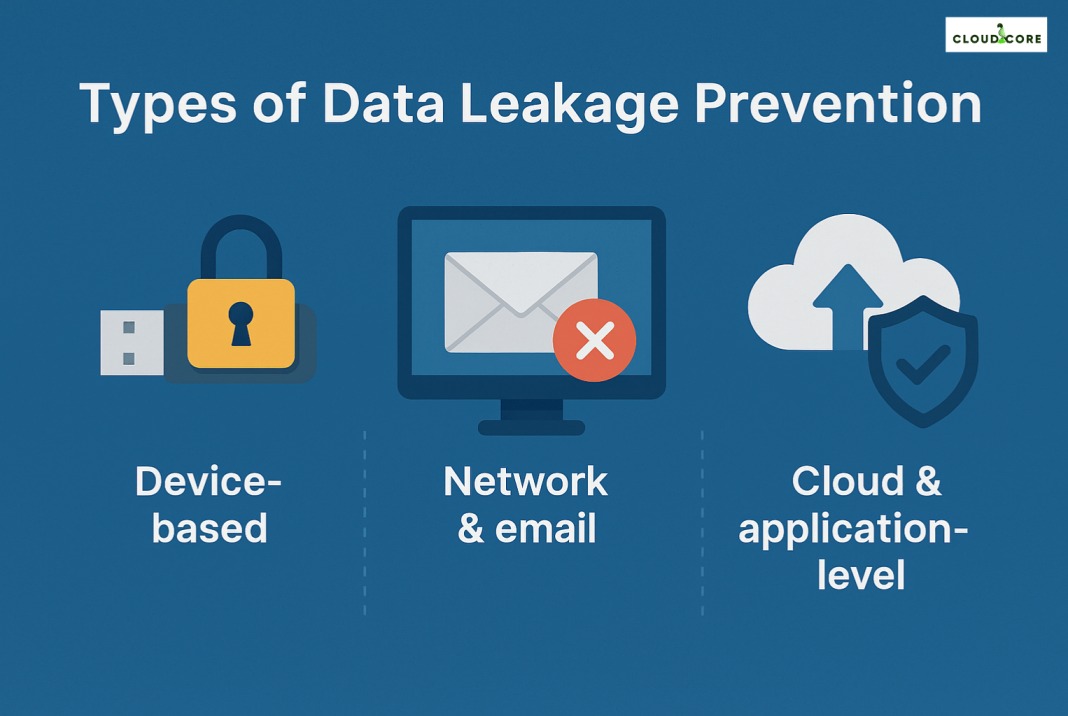
Let's examine the types of data leakage prevention to understand where leaks occur and how to guard against them.
1. Device-based leakage prevention
Removable media such as USB drives or external hard drives are common leak vectors.
Techniques: blocking unapproved devices, encrypting USB storage, logging transfers.
This type of control is vital for remote or hybrid work environments.
2. Network & email leakage prevention
Outbound email attachments and cloud file sharing are frequent sources of data leaks.
Solutions: email gateway DLP, cloud upload scanning, network egress monitoring.
These types of data leakage prevention are crucial for compliance-heavy industries.
3. Cloud & application-level leakage prevention
With SaaS and cloud adoption, this has become one of the most vital types of data leakage prevention.
Techniques: CASB integration, API-level controls, and behaviour analytics to ensure data within apps doesn't leak beyond approved boundaries.
Developing a Data Leakage Prevention Policy
A robust strategy must include a clearly defined data leakage prevention policy—a document that outlines expectations, responsibilities, and enforcement mechanisms.
Key components of a policy
- Data classification schemes: define what's "sensitive," "internal," or "public."
- Assigned roles: specify who will monitor, enforce, and remediate.
- Approved and unapproved data transfer methods (USB, email, print, cloud).
- Incident-response procedures for detected leaks.
- Regular auditing and review cycles to evolve with emerging risks.
Tips for enacting the policy
- Provide continuous training aligned with your data leakage prevention policy.
- Monitor and log data flows proactively.
- Align with
- Test your data leakage prevention policy controls regularly.
- Integrate controls seamlessly to avoid hindering productivity.
Integrating Both Strategies into a Unified Data Protection Framework
Rather than treating data loss prevention vs data leakage prevention as separate silos, organisations should unify both into a single framework.
A unified approach ensures:
- Centralised policy management that covers all types of data leakage prevention and loss prevention.
- Backup & disaster recovery integration, supported by
- Continuous monitoring of data integrity, availability, and movement.
- Alignment with compliance frameworks such as ISO 27001 and HIPAA.
How Cloudcore Can Help Your Organisation
At Cloudcore, we deliver a complete portfolio of services supporting both data loss prevention vs data leakage prevention initiatives.
| Service | Description | Supports DLP/DLP |
| Managed Security Service | 24/7 monitoring & incident response | Detects leaks and loss events |
| Security Consulting | Tailored advice | Integrates DLP & DLP strategies |
| Backup as a Service | Secure off-site backups | Prevents data loss and supports recovery |
| Private Cloud Security | Secure hybrid infrastructure | Prevents leaks via access control |
| Compliance Services (ISO 27001, HIPAA) | Regulatory assurance | Combines both strategies for compliance |
Conclusion
In summary, the debate on data loss prevention vs data leakage prevention isn't about choosing one—it's about integrating both. Protect your data from loss through recoverability and integrity, while guarding against leaks through control and prevention.
By combining a unified framework, a clearly defined data leakage prevention policy, and awareness of all types of data leakage prevention, organisations can ensure complete data resilience and compliance.
Ready to act? Contact Cloudcore to build your tailored data-protection strategy today.
FAQs
What is the difference between data loss prevention and data leakage prevention?

Why is a data leakage prevention policy important?
What are the main types of data leakage prevention?
Can one tool handle both data loss prevention vs data leakage prevention?
How do compliance frameworks align with DLP strategies?
What are common mistakes in DLP deployment?
Treating it as a one-time setup, weak policies, ignoring cloud controls, and not testing incident responses.
Get in touch
Whether you need help with cloud integration, performance optimization, or simply want to explore a partnership

Your ideal service provider for secure, efficient, and scalable cloud solutions.


© 2024 Cloudcore. All rights reserved.