


Table Of Content
UAE Compliance Requirements: Why They Matter?
Compliance standards are more important than ever for businesses of all sizes in today's world, where digital data can easily cross borders, and cyber threats are getting smarter. They help us follow legal, regulatory, and moral standards, especially when working with private information, running IT systems, and keeping people's privacy safe.
Cloudcore compliance services, such as Managed Security Services Provider (MSSP) and Vulnerability Assessment Penetration Testing (VAPT), help businesses understand and follow the rules that are in place. Contact us if you need a personalized consultation to help you with your compliance plan.
The rules for local compliance and international compliance are different if you do business in the UAE and have clients in the US. Ignoring them could get you in trouble with the law, cost you money, or hurt your image.
I'll guide you through the workings of these compliance systems, why they are significant, and how you can remain an industry leader.
Understanding Local Compliance: Why Regional Frameworks Are Critical.
Although many organizations pay attention to global standards, neglecting local compliance can turn out to be a costly mistake. Laws about data protection and hacking are often made by local governments to fit their own political, economic, and technological situations.
Navigating the UAE's Compliance Landscape
UAE culture has quickly transformed into one that embraces technology to support this digital growth securely, and the country has put in place several localized frameworks that help protect digital systems, especially in critical industries. Sticking to well-known cybersecurity best practices is key to staying in line with compliance requirements and reducing the risk of rising cyber threats in the region.
NESA Compliance: Safeguarding UAE's Critical Infrastructure.
The National Electronic Security Authority (NESA) was formed to protect UAE computer networks against online threats. It provides a specific framework of controls for cybersecurity that is to be implemented by organizations based on their respective level of risk.
Key areas of focus include:
- Network Security and Monitoring
- Secure configurations and system hardening
- Identity and access management
- Incident response preparedness
Organizations that fall under NESA's mandate must not only implement these controls but also regularly audit them to ensure continuous compliance.
UAE IA Requirements: Information Assurance for Public Sector Resilience.
The Information Assurance (IA) framework of the UAE mandates government entities and vital sectors to adhere to policies that secure digital assets, promote data integrity, and protect national interests.
Some core requirements include:
- Data classification and secure sharing practices
- Risk assessments for internal systems
- Business continuity and disaster recovery plans
The IA framework ensures that cybersecurity is embedded into public-sector infrastructure, reducing vulnerability to targeted attacks.
ADHICS Compliance: Protecting Health Data in Abu Dhabi
The Abu Dhabi Healthcare Information and Cyber Security (ADHICS) standard regulates the management of sensitive health records by healthcare organizations. It protects the confidentiality and integrity of medical information throughout the emirate.
What makes ADHICS particularly impactful?
- All data must be encrypted both during its transit and storage processes.
- Healthcare companies need to set up complex ways to control who can see what.
- Aligns with international best practices such as HIPAA, making interoperability achievable for global collaborations.
The Abu Dhabi Health Information and Certification System (ADHICS) rules are the most important thing for healthcare centers and insurance companies in Abu Dhabi to follow.
Local Compliance Challenges to Avoid
Implementing international frameworks without considering local compliance specifics often leads to incomplete alignment and potential risks. It is a concern for me because the increasing costs associated with cyber incidents, as highlighted by alarming data breach statistics, show that neglecting localized requirements can result in significant vulnerabilities for our organization.
Common issues include:
- Overlooking mandatory government cybersecurity notifications
- Incorrect data according to local laws
- Not training staff in region-specific policies
Apart from the business details, it's important to know and follow the local rules and customs.
Introduction to International Compliance Standards
As we constantly observe global data flow, international compliance is crucial for businesses to build trust, enter new markets, and run smoothly. Several important frameworks exist to guide international cybersecurity, risk management, and data privacy.
SOC 2 Compliance: Building Trust in Customer Data Handling
The AICPA created the SOC 2 framework, an essential framework for service-based companies that deal with customer data. It assesses these organizations based on five trust service criteria.
Security
- Availability
- Processing integrity
- Confidentiality
- Privacy
SOC 2 goes beyond technology safeguards to evaluate how well an organization's controls have performed over time. Third-party checks must be done regularly for businesses to build trust with regulators, customers, and business partners.
IASME Cyber Assurance: A Practical Framework for SMEs
IASME Cyber Assurance Standard makes it simpler and cheaper for small and mid-sized businesses to get certified in cybersecurity, covering some elements of GDPR, ISO 27001 and risk management.
This UK-based framework is ideal for SMEs that want to:
- Prove due diligence in cyber protection
- Exceed procurement standards set by both public and private sectors.
- Demonstrate baseline security to stakeholders.
Startups that want cost-effective and scalable ways to meet legal requirements will find ASME very useful.
ISO 27001 Consulting: Help from Experts to Create an ISMS
It tells you how to make, use, control, and keep improving an Information Security Management System (ISMS). ISO 27001 is an internationally accepted standard that everyone is familiar with.
Consulting services help businesses with:
- Gap assessments and risk analysis
- Developing policies, controls, and internal audit procedures
- Employee training and documentation
ISO 27701 Consulting Services: Enhancing Privacy Through PIMS
Meeting the requirements of ISO 27001 builds trust with customers and makes internal information security management stronger. The goal of ISO 27701 is to protect and keep secret personal information, much like ISO 27001 does. The international data privacy regulations say that it helps companies show that they are serious about keeping their customers' personal information safe.
Key components include:
- Privacy risk assessments
- DPIA (Data Protection Impact Assessments)
- Privacy by Design (PbD) implementation
This standard is very important as we move through a world marked by GDPR and CCPA rules.
HIPAA/HITRUST Compliance: Meeting U.S. Health Data Protection Benchmarks.
Organizations dealing with protected health information (PHI), particularly healthcare and technology organizations, must adhere to HIPAA and HITRUST regulations.
HIPAA mandates rules around:
- Health data transmission and storage
- Patient rights and data access
- Administrative, physical, and technical safeguards
HITRUST certification means an organization follows tough, comprehensive rules to protect health information, blending the best standards from different regulations. It's a sign that healthcare companies and their partners are committed to data security.
International vs. Local Compliance: Key Differences and Similarities.
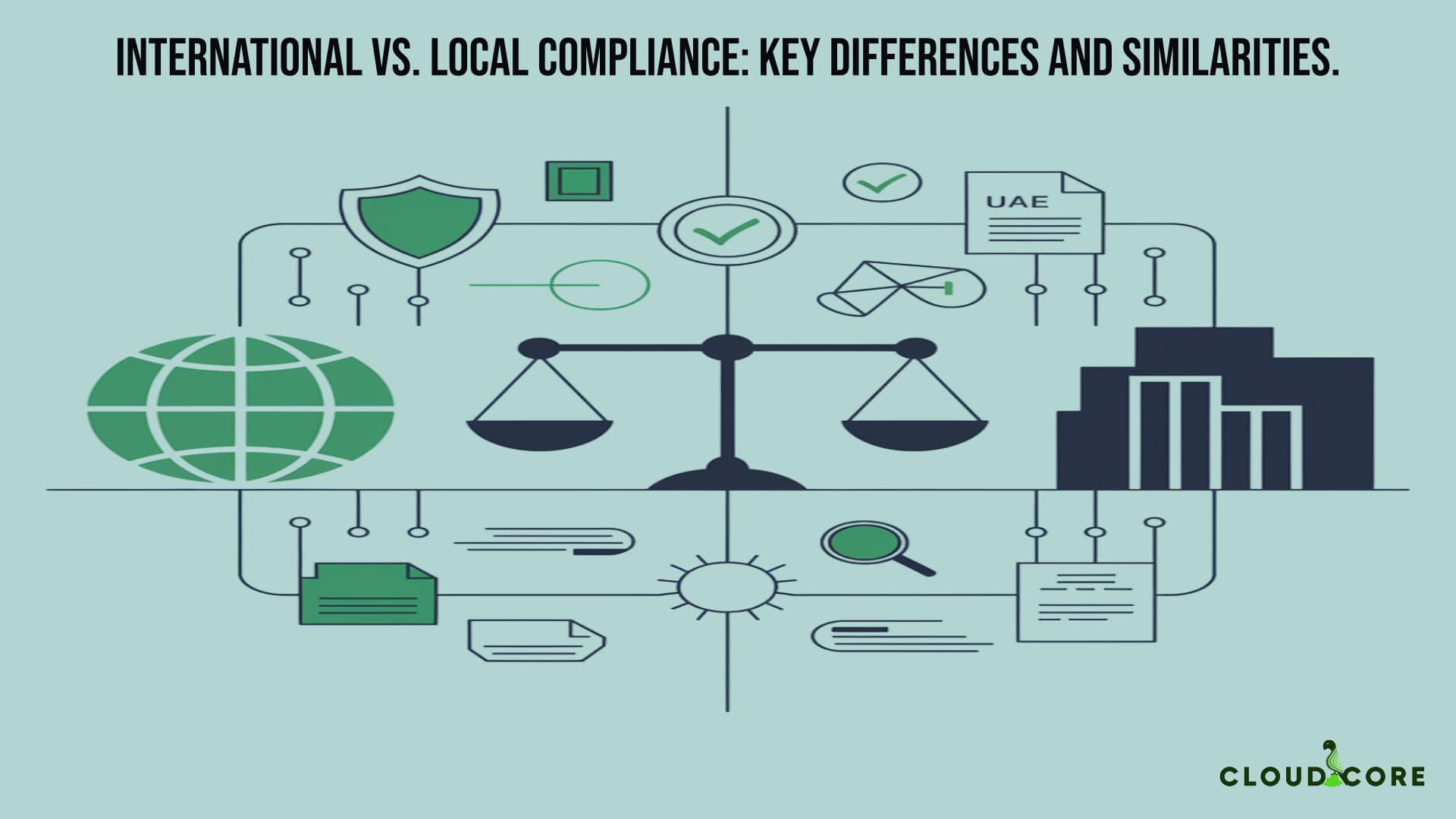
Local compliance deals with the specific rules and laws of a particular country or region for security. International compliance involves broader, globally recognized standards that promote trust and allow systems to work together across different countries.
Key Differences
| Local Compliance | International Compliance |
| Country-specific regulations | Globally recognized certifications |
| Often mandatory by law | Often voluntary, but industry expected |
| Influenced by national interest | Influenced by global best practices |
Similarities:
- Both emphasize data security and integrity.
- Both require continuous monitoring and regular audits.
- Both support risk management and reputation preservation.
Conclusion: The Future of Compliance Requirements
Today's connected digital environment makes compliance requirements, not just boxes to tick but rather an essential element of business strategy, and local compliance rules such as NESA to global trust through international compliance standards such as ISO 27001 or SOC 2, being compliant are vital in protecting your business, building trust with customers, and opening doors for growth opportunities. Companies that approach compliance as an ongoing task rather than a one-time task are more likely to thrive in our complex regulatory world.
FAQs
What are compliance requirements in cybersecurity?

How do local compliance frameworks differ from international standards?
Are you not sure if you need ISO 27001?
Can SMEs afford compliance certifications like ISO or SOC 2?
What industries must comply with HIPAA or HITRUST?
How can businesses stay compliant over time?
Through regular audits, ongoing training, updated policies, and real-time monitoring tools.
Get in touch
Whether you need help with cloud integration, performance optimization, or simply want to explore a partnership
Your ideal service provider for secure, efficient, and scalable cloud solutions.


© 2024 Cloudcore. All rights reserved.